The Sons of Katie Elder

The Sons of Katie Elder
"First, we reunite, then find Ma and Pa's killer...then read some reviews."
Showing posts with label Paul Sorvino. Show all posts

Tuesday, December 2, 2014

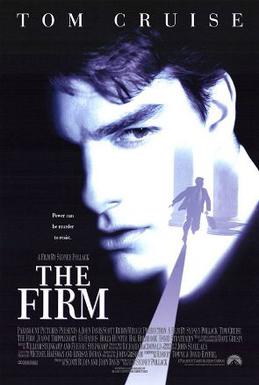
The Firm

So this John Grisham fella, he's a pretty decent writer I hear. A specialist in legal thrillers, Grisham has a long list of bestselling books to his name. Growing up though in the 1990s, I was at that age where neither the books nor the film adaptations really appealed to me. In 1995, 10-year old me wasn't too interested in the world of law. Go figure. The positive? 20-something me has gotten to catch up with both the books and the movies! Today's flick is 1993's The Firm.

Graduating from Harvard Law School, Mitch McDeere (Tom Cruise) has the world at his fingertips. Job offers from countless impressive, prestigious law firms are flowing in, and Mitch is able to make the decision on his own. He accepts an offer from Bendini, Lambert & Locke, a small, tax/accounting firm in Memphis. Their offer blows the others out of the water, and everything about the firm seems too good to be true. The family-like atmosphere appeals to Mitch so with his wife, Abby (Jeanne Tripplehorn), he moves to Memphis with his new house, new Mercedes and new job. He fully commits himself, a talented lawyer pushing himself to his absolute limit and testing his marriage with Abby because he's so committed to making this job work. His goals are pure, but maybe the job isn't? Mitch begins to suspect there's far more going on behind closed doors than he's being told. What secrets is the firm holding?

I'm a book nerd too on top of my movie nerdiness. If there's a book available of a forthcoming flick, I'll typically try and read the book first, and this Grisham novel/adaptation combo was no different. One of the author's most famous books, The Firm was an excellent read. Well-written, good story, cool/interesting characters. The film adaptation from director Sydney Pollack has all those ingredients and for the most part, works pretty well. It was filmed on-location in Memphis with the city serving an excellent backdrop to the story. The characters are fascinating, and the cast is impressive in its depth and talent. I don't usually criticize soundtracks, but I thought this Memphis blues (with a lot of piano) infused score was a big flop overall as well, to the point the score becomes a distraction because it didn't fit with the tone and rhythm.

Now onto one of my movie theories. Ah, screw it, theories in general! I call it the Christmas Eve theory. Do you want to know what your presents are or is the mystery and the build-up and the anticipation the best part? The mystery here works in a big way -- we're talking epic SENSE OF DOOM -- and the payoff does too. No Spoilers here though, sorry. It's the execution after the reveal that didn't work as well for me. The screenplay takes some giant liberties with Grisham's novel, making changes that severely alter characters, the entire story, the motivations and the payoff in the end. It's a long movie to begin with at 154 minutes, but I found myself drifting in the second half. There's some really intense, life and death chase scenes that are exhilarating to watch but things get disjointed in a big way. The ensemble gets lost in the shuffle, and the scene with the payoff feels almost laughable. Talk about a disappointment in the finale.

With all that said, the movie is still worth watching. Starting with Cruise, the cast is pretty impeccable. In quite a string of successful movies, Cruise is an excellent lead. Reading the book, he wasn't what I thought Mitch would look like, but the casting works. Cruise brings the right amount of confidence and smarts and then intense terror to the character. This isn't a flawless character -- thankfully -- but an interesting one. Of the supporting performances, I thought Gene Hackman was the best. Go figure, Gene Hackman being good at acting! He plays Avery Tolar, a partner at Bendini and Mitch's mentor who's supposed to take the young lawyer under his wing as he preps for the BAR exam. Their scenes as they meet and get to know each other feature some of the movie's strongest scenes. It's two actors going toe to toe, one holding the firm's secret, one trying to carve a niche out for himself.

Who else to look out for? LOTS of folks. Start with Hal Holbrook and Jerry Hardin as two heads of the firm who recruit Mitch to join Bendini. Wilford Brimley and his impressive mustache are quite imposing (and unintentionally funny at one line) as DeVasher, the firm's head of security. Helping Mitch figure out exactly what's going on are Gary Busey as a private detective and Holly Hunter as his sexy Southern secretary. Pushing Mitch to make a life-altering decision are some government officials -- cough FBI cough -- in the form of Ed Harris (with a shaved head and angry demeanor) and Steven Hill (taking a break from Law and Order). And also, look for David Straithairn as Mitch's brother, Ray, who has a secret that could cripple them all. Last but not least, also look for Paul Sorvino, Tobin Bell, Dean Norris, Margo Martindale, and Joe Viterelli in some other key supporting parts I don't want to give too much away about.

I wanted to like this movie more than I did. All the potential is certainly there from the cast to the novel to the directing (Pollack is a favorite of mine). It just never quite lives up to that potential. The first half is better than the second half, but the ending disappoints, limping to the finish. I sound like that guy, but the book is better than the movie. Oh, and Tom Cruise runs for his life around Memphis a lot so there's that.

The Firm (1993): ** 1/2 /****

Monday, October 6, 2014

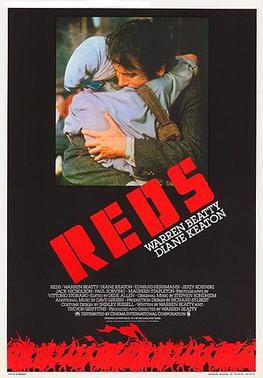
Reds

The amount of information, facts and tidbits I don't know about Russian history could full volumes. I love history -- ALL of it -- but something about the immensity of Russia and its history has proved rather intimidating to me. Where to even start? Well, movies seem to agree with me. I liked but didn't love 1965's Doctor Zhivago, but there's another Russian epic that's long been recommend to me. Let's get going with 1981's Reds.

Living in Portland, Oregon in 1915, Louise Bryant (Diane Keaton) has a relatively safe if dull life. She's married, does art and is a hopeful writer. Then, she meets John Reed (Warren Beatty), a highly respected if somewhat controversial writer with an impressive following. She is immediately drawn to him and ends up following him to New York City to be with him while also hopefully pursuing a career as a writer and a journalist. There's a relative catch though. John is a staunch supporter of the socialist movement, a movement that threatens to tear World War I apart as workers around the world, especially in Russia, begin to push for more rights, more privileges. In the midst of World War I (and with the Russian Revolution looming), Louise has entered into one of history's most tumultuous times. She loves John and he loves her, but the world seems on the brink of blowing itself up. What will happen next?

For years, my Mom has recommended this movie to me. It's one of her all-time favorites, and she knows far more about the time and backstory than I do. For some background reading, read about the Russian Revolution HERE at Wikipedia. It's not even fair to say this is a Russian Revolution movie. This is a story about two people's lives amidst that turbulent time in world history with a heavy socialist focus. For more reading, read about John Reed and Louise Bryant, two incredibly interesting individuals. It is a big, epic movie, clocking in at equally intimidating 194 minutes, and took Beatty (who starred, directed, produced and wrote) and his cast and crew a full year to film. That's before you consider a lengthy editing process. Beatty is no dummy, taking on films that mean something to him, and this is the definition of that. This is a message movie, an intellectual, thought-out, impressive film. Is it good though?

I will say it is more interesting than it is good, if that makes sense. 'Reds' picked up 12 Oscar nominations, ultimately winning three, including Beatty as Best Director. For a movie that clocks in at almost three and a half hours, it did well at the box office and resonated with critics and has developed quite a following among fans. It was filmed in New York City, Finland, England, Sweden and Spain. So....yeah, what else? 'Reds' is an epic. The scale and immensity is impressive. This is an epic about an idea though, the idea of socialism. This is 194 minutes of almost entirely talking. This is talking about a principle, about government, about corruption, about history, about the system. 'Reds' isn't Lawrence of Arabia or The Godfather or Gone With the Wind. It is its own epic, and with Beatty backing it all the way, it is quite okay with being its own film. I struggled at times because it is such a smart, well-written movie. Is that enough to hamstring a film? I don't know, but definitely know what you're getting into here.

Picking up two of the film's four Oscar acting nominations, Beatty and Keaton carry the film. Either one or the other is in almost every scene, and apparently the filming was so strenuous on their off-screen relationship they ultimately broke up. I didn't necessarily buy their doomed love, their unexplained chemistry. What did I buy? Their performances themselves are excellent. These are two extremely intelligent individuals, drawn to each other but who's personalities butt heads because they're both so strong-willed. Based on historical figures, both characters are 3-D, blood and guts people, not cardboard cutouts. Kudos to both actors who again make their characters interesting/fascinating if not necessarily likable.

Up until 2012's Silver Linings Playbook, 'Reds' was the last film to receive Oscar nominations for all four acting categories. The culprits? Jack Nicholson as playwright/writer Eugene O'Neill and Maureen Stapleton as famed anarchist Emma Goldman. These aren't huge supporting parts, but what's there is choice, two actors making the most of their relatively small screentime. Also look for Edward Herrmann, Jerzy Kosinski, M. Emmet Walsh, Paul Sorvino, William Daniels, Gene Hackman, and R.G. Armstrong in supporting parts. Some of them are pretty quick, none of them truly developed, and a couple are nothing more than a single scene. Of the smaller parts, Kosinski is memorable as a socialist leader working with Reed and Hackman as a booze-loving, honest newspaper editor.

One of the best choices Beatty makes as a director was a wise style choice. Along with the actual story, interviews with those who knew Reed and Bryant during the 1910s and 1920s are interspersed throughout the movie. These people -- now in their 70s and 80s -- reminiscing about John and Louise, about the times, about how things have changed, these are the moments that proved most memorable for me. Check out the list of witnesses HERE. So as I mentioned before, this is an excellent movie. One you appreciate and admire and respect. I felt like I learned some things as the story develops, but did I love the movie like I hoped I would? Nope. Still very much worth checking out, but not quite the movie I was expecting.

Reds (1981): ** 1/2 /****

Wednesday, June 25, 2014

Mr. 3000

Maybe more than any other sport, baseball loves its numbers, records and milestones. Cal Ripken's streak of games played, Hank Aaron's home run record, Cy Young's wins total, Nolan Ryan's strikeouts, Pete Rose's hits total. There are certain milestones that if you reach during your MLB career, you become a legend, an icon, and usually, a Hall of Famer. It is the driving force behind this 2004 comedy, Mr. 3000.

It's the 1995 MLB season and the Milwaukee Brewers are in the midst of a pennant race. Their star player, first baseman Stan Ross (Bernie Mac), though is focused on bigger and better, or at least more personal things. He's edging ever closer to getting his 3,000th career hit, a mark that will put him in an elite club in baseball history. When Ross gets that historic hit, he shocks everyone, retiring in the middle of the season with the Brewers poised to make a big playoff run. Some nine years pass, and Ross is edging closer and closer to being voted into the Hall of Fame, just a few votes needed to put him over the top. Not so fast though, a clerical error is found in his stats. Stan doesn't have 3,000 hits. He has 2,997 career hits, putting his Hall of Fame status in serious doubt. His only alternative? Almost a decade out of baseball, Stan signs with the Brewers late in the season -- a disappointing season at that -- with hopes of chalking up three more hits, getting him back to 3,000 and back into the Hall of Fame conversation.

I love baseball. Love just about everything about it. So baseball movies? Yeah, I'm already in line with everything from Field of Dreams to Major League, The Sandlot to Bull Durham. Even the bad movies can be good in a guilty pleasure sort of way. And that's where Mr. 3000 falls. From director Charles Stone III (he also created and starred in the Budweiser 'Whassup?' commercials), '3000' just isn't a good movie. Is it mildly entertaining? Yes. But as a quality story, nope, no way. It's an easy movie to sit back and kinda turn your brain off. As a baseball fan, it has a handful of good moments but mostly drifts along. I'll give it credit where it's due. The ending provides a twist of sorts, but it is definitely hinted at so if you're paying attention early, you should see what's coming. That said, it still works for the characters and story.

You know what I like in movies? A likable character. No, not 4 or 8 or 15. I settle for one likable character, and this movie has N-O-N-E. The Stan Ross character is a crossbreed between Barry Bonds (a lovable, cuddly player if there ever was) and Charles Barkley (who's become a fan favorite and very likable after retiring courtesy of his TV gig) so we're intentionally not supposed to like him but come on. Give us something here. Bernie Mac was a very funny comedian, but talk about an awful character. All about himself to the point of being stereotypically over the top -- he actually rips his 3,000th hit ball away from a little kid -- that even when he goes through a character "arc" you're not really rooting for him. He tries to get back together with a past love (Angela Bassett), an ESPN reporter who blatantly roots for him in the press box, but even that can't humanize him too much. His more redeeming moments come when Stan realizes how much he's done wrong, but the script requires him to quickly punt on that thought when Jay Leno wants him to come onto his show. Screw practice, let's go talk to Jay Leno!!!

So unlikable main character? Check. Let's flesh things out with more unlikable characters! Chris Noth is the slimy Brewers GM who sees a chance for some $ while Michael Rispoli plays Stan's only friend, Boca, a former teammate who now works as a bartender at Ross' bar. Why are they friends? Because....yeah, that's never illustrated. His Brewers teammates include T-Rex Pennebaker (Brian White), a preening, me-first slugging outfielder, Fukuda (Ian Anthony Dale), a Japanese pitcher learning to curse in English, Fryman (Evan Jones), the likable catcher, and Minadeo (Amaury Nolasco) and Skillet (Dondre Whitfield), the bickering middle infielders who compete over everything. Paul Sorvino is silent for 89 minutes of a 104-minute movie, not speaking until almost 90 minutes in, as the Brewers' old school manager.

Not a truly bad movie, but pretty close. It is mildly entertaining, and that's all. The baseball scenes don't scream out authenticity, and Bernie Mac doesn't exactly look like a baseball player at any point. You're not really rooting for anyone, and even the ending provides a cop-out after that semi-decent twist in the final game of the season. A pretty meh movie overall.

Mr. 3000 (2004): * 1/2 /****

Thursday, November 7, 2013

The Gambler

I've been to casinos exactly twice in my lifetime. It's easy to see what the appeal is, and I think that's what I avoid it. I can easily see myself thinking I'll earn millions and quickly busting my bank. Ah, the appeal of gambling from sports bets to poker to slot machines. Quite a jumping off point for a movie, hhmm? Maybe like 1974's The Gambler.

An English professor at a university in New York City, Axel Freed (James Caan) has a gambling problem, and this time, he's dug himself quite the hole. Gambling at an illegal casino, Freed loses $44,000 which he doesn't have, forcing him to improvise before the bookie's thugs come after him. This isn't anything new for Axel who's long struggled with gambling, but recently seemed to have gotten a grip on his addiction. He only has a few days to get his hands on the money, turning to his mother (Jacqueline Brookes) who is a doctor at a free clinic. Worrying about her son's well-being, she scrapes the bottom of the barrel to get the money Axel needs, begging her son to pay his debt and walk away from gambling. That would be the easy way to do it, wouldn't it?

From director Karel Reisz, 'Gambler' is one of those hidden gems from the 1970s. It doesn't have a huge reputation, and it can be more than a little tricky to find. It was on my Saved DVD queue at Netflix for months only to pop up on a movie channel recently. And record! I'm glad I caught up with it. Besides an excellent leading performance from James Caan, it has that perfect blend of 70s grittiness and style (but not too much). It was filmed on the streets and homes and illegal casinos in and around New York City, a great backdrop for a whole lot of movies in the 1970s. Jerry Fielding's musical score is perfect, subtle and underplayed for the most part, elevating the tension when needed as Axel struggles to cope. It certainly deserves more of a reputation for all it's got going for it. Solid drama, no frills, and that's not a bad formula.

One of my favorite actors, James Caan was struggling through his own addiction to cocaine while filming this movie, and even identifies it as one of his personal favorites in terms of roles. It's easy to see why. Caan brings Axel to life, a human being with an addiction more than a stereotype or one big cliche. Axel is successful with an excellent job as a professor, his friends and family, a girlfriend (a solid Lauren Hutton), and in general, a lot going for him. He also has a problem. Whatever he gets involved in, he's always looking for "the juice," in other words the thrill of winning, or bizarrely....losing. He tells his friend, Hips (Paul Sorvino), also his bookie, that he could make any number of bets that are sure things. What's the point then? Where's the thrill? There's got to be a possibility of losing for it to feel real, to feel the rush. It's a really simple concept that is pretty scary when you think about it.

Caan does a fine job building off that. His Axel has everything a man could/should want. That's not the definition of a self-destructive fellow now, is it? Through all the people he drives away -- friends, family, girlfriend -- he still somehow manages to make Axel Freed somewhat, remotely, kinda sorta sympathetic. Are we actually rooting for him? Maybe not, maybe we're just rooting for him not to get the crap beat out of him. He pulls cons and fast ones on just about everyone around him, but there's something very human about the character. I guess we're not rooting for him. Instead, it's more how he'll get out of one more self-caused problems. We want to see how low he'll really get, and Caan's Axel certainly pushes the limits there. It's a great, understated performance that avoids all the obvious pratfalls that could come with the part.

The cast doesn't feature much in the way of big names, but that opens the door with some potential. We meet all these people who Axel knows -- for good and bad -- like a window into the gambling world. Brooks is heartbreaking as his mother, Naomi, wanting what's best for her son but knowing she's enabling him at the same time. Hutton is very good as Billie, his girlfriend who sees him spiraling out of control. Sorvino is excellent as bookie and friend, Hips, who genuinely likes Axel but knows he's pushing the limits of their friendship. Also look for Burt Young in an effective, quick part as a bookie's enforcer, Morris Carnovsky as Axel's very rich, very successful grandfather, Carl W. Crudup as Spencer, one of Axel's students and a star player on the basketball team, and even a very young James Woods as a bank teller who incurs Axel's wrath.

If there's a weakness it comes in the finale. I'm not sure exactly what it's trying to say or what it's going for. The finale the story was seemingly building to seemed pretty obvious to me, but 'Gambler' doesn't go quite that far. It's not a bad ending, just one that isn't as strong as it could have been. I liked the movie a lot though, Axel's lectures in class ending up being a reflection on himself. Caan is pretty perfect in the part, one that any fans should definitely seek out.

The Gambler (1974): ***/****

Thursday, January 21, 2010

Goodfellas

If there is one thing director Martin Scorsese knows -- and I'd say he knows a lot more than that one thing but just go with me -- it is the gangster/mobster movie, a theme he has gone back to the well for several times, starting as far back a 1973's Mean Streets and continuing through 2006's The Departed with a few ventures spread through the years in between. With other successful movies like Gangs of New York, Raging Bull, The Aviator and Taxi Driver, Scorsese is shown he is more than just a one-trick pony, but for many fans he will always be associated with gangsters and mobsters.

Is it really a bad thing to be known for success with one type of movie? Scorsese is far from being typecast, and he can make any movie he wants at any time he wants to so I wouldn't say he's been typecast. What sets all his gangster movies apart from your average mobster flick is that he brings the underworld to life in a way where the viewer can appreciate all aspects of the life. One, there's the bond, the camaraderie that develops among these crooks, making the life almost seem glamorous, Second, the not so nice end, the betrayals, double crosses, murders left and right. Nowhere are both aspects handled better than 1990's Goodfellas.

Growing up in 1955 New York, half-Italian, half-Jewish teenager Henry Hill wants nothing more than to be a mobster. Living with his family across the street from a mobster's hangout, Henry sees the life and knows he wants to be a part of it. So he gets a job working for the local boss, Paul Cicero (Paul Sorvino), and starts working his way up the ladder. Fast forward seven years and a 20-something Henry (Ray Liotta) is a powerful member of Cicero's crew and showing no signs of slowing down. Working with Irish hitman Jimmy Conway (Robert De Niro) and livewire psycho Tommy DeVito (Joe Pesci), Henry continues to make a name for himself.

He marries a Jewish girl, Karen (Lorraine Bracco), and starts a family with the nice suburban house. Everything seems to be in Henry's favor as the money from all his *cough* business ventures continues to roll in. But how many times have we seen this story? For every meteoric rise to the top, there's also the inevitable downfall. Based on a book called Wiseguy, Goodfellas brings you into the life of a mobster like few other movies have -- sometimes to the detriment of the story, but more later on that. Henry serves as the narrator (Karen gets a few voiceovers too), explaining and illustrating background in a few sentences that would have taken whole scenes to describe.

And working with a true story as a source, Scorsese nails the scenes with these underworld personalities. The dialogue crackles with energy, the banter between these guys is unbelievable, blunt, in your face, filthy, and generally as politically incorrect as possible. These scenes also serve to show the tight-knit bond and culture these guys share -- sometimes for good, sometimes for bad -- having chosen a "job" that will most likely end with a jail sentence or a bullet in your head.

For years, all I heard were positively glowing reviews for this movie, and I'm not disagreeing but parts are both sluggish and too fast-paced at the same time. In 145 minutes, Scorsese covers 25 years of story with some parts going by too quickly and then the whole last 30 minutes devoted to a single day. And as good as Bracco is as long-suffering wife Karen, the segments dealing with Henry's family don't have the same energy as the rest of the movie. That's not to say these scenes aren't good, but it never feels like I'm watching anything I haven't seen before.

The scenes that are on par with everything Godfather I and II offers are with Henry, Jimmy and Tommy. It's the type of role for Liotta that makes me question why he never became a bigger star. He might not have the most glamorous part here, but don't fool yourself...this is his movie, and he's the star. De Niro and Pesci (who won a best supporting Oscar) have parts that don't require them to be in every scene so their characters drift in and out of the story. But when they are on-screen, it's some of the best scenery-chewing (thank you Netflix for the description) you'll ever see. Pesci is a lunatic (watch this classic scene), ready to blow somebody away for insulting him, and De Niro isn't too far behind. Great parts here for two great actors.

Picking this movie on my Netflix queue, I wanted to love it but only ended up really liking it. All the Scorsese touches are there, the great rock soundtrack used to perfection, the amazing script, and that dark humor that works so well in stories like this, like THIS scene where all the mobsters are introduced. All the positives definitely outweigh the negatives, and I'm definitely recommending this one, but I'm a little disappointed I didn't like it more.

Goodfellas <----trailer (1990): ***/****