During the Great Depression when families had very little money, going to the movies provided a cheap alternative to more expensive field trips. And above all else, some genres appealed to audiences more, especially gangster flicks with stars like James Cagney and Edward G. Robinson among fan favorites. Their popularity waned, but the damage – in a good way – was done. A generation of young directors were influenced heavily by these films, and then grew up to make their own personal gangster films.
This influence was especially noticeable in French films, more specifically French New Wave, starting in the late 1940s and continuing on into the 50s and 60s. These were usually darker stories heavy on style that tended to live in the underworld of crooks, criminals, and gangsters. Of course, these weren’t low level thugs who looked one step above a homeless person. These gangsters were well to do, wearing a suit and a fedora, dropping huge amounts of cash wherever they went with a woman always on their arms, and a cool jazz soundtrack playing as a soundtrack.
What is so surprising with so many of these movies is that the gangsters – typically villains in most American movies – end up being the sympathetic figure amidst all the violence and chaos. They’re on the wrong side of law, but somehow it’s easy to look past their profession. In Jacques Becker’s 1954 gangster flick Touchez Pas au Grisbi, Jean Gabin is Max, a slightly past his prime gangster looking to get out of the business. That’s a storyline that is as old as movies itself, but Becker’s movie is an underrated and forgotten classic.
A respected and well-liked gangster, Max is hoping to get out of the business as he sees all the young men taking over. With his long-time partner in crime, Riton (Rene Dary), Max has pulled off one last heist that netted the duo $50 million in gold bars. But in trying to impress his younger girlfriend, Josy (Jeanne Moreau), Riton spills their secret, and it’s not long before Josy tells her new boyfriend, a ruthless mobster, Angelo (Lino Ventura), who quickly forms a plan to get his hands on the gold. Now instead of looking to put his criminal past behind him, Max is forced to fend off Angelo’s deadly attacks if he wants to hang on to his gold.
These French gangster movies are heavy on style but never at the expense of the story. That’s not to say the stories are overly complicated (‘Touchez’ is based on a French novel), but there also aren’t twists and turns in the plot around every corner. Becker films in black and white, giving the Parisian night both eerie and intimidating while also creating an incredibly visual experience. There’s something appealing about the simplicity of the story. Of course, it is a product of the times, and these French New Wave gangster movies aren’t exactly known for their happy endings. This isn’t as downbeat as say Le Samourai or Breathless, but its close.
Stepping into that anti-hero role that is so familiar to the crime genre – and many others for that matter, like westerns – Gabin delivers an amazingly understated but still powerfully effective performance as Max. He’s a veteran of the underworld, and there’s little he hasn’t seen. Max is loyal to his friend and partner Riton, even when it would be more logical to cut him loose and work on his own. Everyone seems to like Max who is devoutly loyal to his friends, even rival Angelo who goes after his gold only because it’s a business, not because he’s got anything against him. I haven’t seen Gabin in other movies, but this was quite an introduction. It’s also an obvious influence on Jean-Pierre Melville’s Le Samourai with Alain Delon playing a similar character in tone and demeanor.
Max is a pretty even-keeled guy unless you push him too far. Watching Angelo’s deception provides some tense moments as Max figures things out, and when Riton is kidnapped, Max decides things have gone too far. Working with a local high-ranking gangster (Paul Frankeur) and an up and coming youngster (Michel Jourdan), Max arranges a pick-up, a trade straight up with the gold and Riton. It’s a great sequence, and the one scene with some heavy-duty action. The scene unfolds in the dead of night on a country road with a startling finish that has its fair share of irony with the idea that crime don’t pay. It’s a good kicker to the story that is heavy on style with some strong acting. Don’t be scared by the subtitles, the Frenchies know how to make a gangster movie like nobody’s business.
Touchez Pas au Grisbi <----trailer (1954): *** 1/2 /****
The Sons of Katie Elder
"First, we reunite, then find Ma and Pa's killer...then read some reviews."
Showing posts with label Jacques Becker. Show all posts
Tuesday, February 23, 2010
Sunday, February 7, 2010
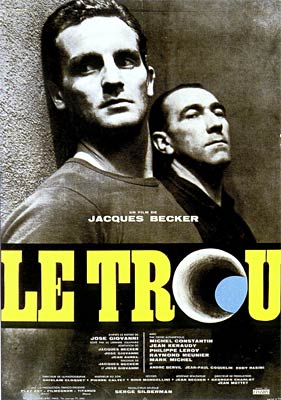
Le Trou
Taking a film history class in college, my first experience with French cinema was a less than impressive showing. Rated highly by fans and critics alike, Jean Luc Godard's Breathless bored me to tears and even produced quite a few out-loud laughs at the choices with the script. I won't say it negatively impacted me and my future opinion on French movies because I never really had more of an interest in seeing them to begin with. Sure enough, after rating enough movies at Netflix, some French movies started popping up as recommendations so I've given them a try. All I can say, I'm glad I didn't give up on those Frenchies.Last year, Jean-Pierre Melville's Le Cercle Rouge was the best movie I saw, and this year, 1960's Le Trou is an early candidate for best movie...personally that is. Directed by Jacques Becker -- who died before the movie was even released -- this is a story that is captivating in every way, surprising considering VERY LITTLE actually happens. Based on a true story of a prison break from a French prison in 1947, this is storytelling at its finest with no wasted moments, no wasted shots. These prisoners are going to escape no matter what it takes, and Becker shows this in excruciating detail. It's a movie that may drive you nuts, but is it ever worth it.
Awaiting sentence for the attempted murder of his wife, convict Claude Gaspard (Marc Michel) is moved from his cell as it undergoes some rehabbing. Gaspard moves into another cell already occupied by four other prisoners, all lower to middle class men who are suspicious of the more upper class new guy. But he gains their trust, and they let him in on their secret. All four men are facing lengthy sentences -- at best, some face death -- and are planning a jail break. Gaspard can join in on the escape as long as he helps out in the process. Claude agrees, and they go about finding a way out. But can they pull it off before any of the five are convicted, or what seems more imminent, Claude being moved back to his original cell?
Brace yourself, I'm pulling out what little movie knowledge I have when it comes to sounding like a movie snob. Becker films 'Le Trou' like a documentary with no music and a minimalist style. His camerawork is never invasive and allows the viewer to be the fly on the wall in this cramped little cell where five men have been forced to live. Casting these five men, Becker picked four relatively unknown actors and one person who was a real-life prison escapee. Along with Michel's Gaspard, there's Geo (Michel Constantin), Roland (Jean Keraudy, the real life convict), Manu (Philippe Leroy), and Monseigneur (Raymond Meunier). We're given little to no background about these four men, but by the end you're fully rooting for them to pull off the impossible and get out for good.
This lack of backstory is essential because the story keys in exclusively on the relationship among these five men and their one, united goal of escape. Everything else would have just been fat on the bone. The techniques used in the escape are nothing new, just men putting their head down and going to work. Instead of a montage of the process, Becker uses long shots with no cuts, like when the cellmates break through the floor with a crowbar. The shot goes on and on as one by one these men tire before passing the bar off. There's nothing going on other than the bar hitting the concrete slab (we don't even see the faces, just hands and crowbar) and the tension built up is indescribable. They do seem to be making a lot of noise -- one of the few flaws in the movie, no one hears what's going on? Really? -- in the process.
Several scenes like that eat up several minutes that are oddly transfixing in their execution, but the best segment is an almost 25-minute scene (starts HERE and continues into the next two segments) as the escape process is revealed. They've broken through the floor and come out in the prison's extensive cellar that's linked by pitch black corridors. The goal? To find a sewer shaft that goes out under the wall of the prison and out to freedom. Manu and Roland walk through these corridors, very aware guards are patrolling the same shadowy, poor lit areas, trying to find the shaft. It's an incredible sequence that unfolds in real-time until they find out they'll have to tunnel their way around another concrete wall, only to realize it's almost time for a bed check. Ranks with Rififi's heist sequence as one of the most riveting ever committed to film.
Lost in the reality of the movie is the incredible job done by these actors in portraying their characters. Claude is given the most background, Geo some, Roland is an expert escapee, Monseigneur is the elder statesman, and Manu is suspicious of Claude. That's pretty much it, but by the end it feels like we've somehow gotten to know these men. No background and dialogue is kept to a minimum, but even then, the characterization still works. Keraudy was not an actor but still delivers one of the best performances I've ever seen, subtle but strong, and Leroy's Manu is just as impressive. He holds everything close to his chest, but this escape attempt allows him to open up some and trust.
This all builds and builds until it feels like we as viewers have been there with them all along finding their way to freedom. Even at over 2 hours, the storytelling is never dull and keeps you riveted until the very end. As for the ending, it's one of those finales that makes you feel like you've been punched in the stomach...repeatedly. In terms of the movie's tone and story, a happy ending probably would not have worked, but this one just hurts. It's an incredible ending though and features one of the creepiest reveals I've ever seen in a movie just in terms of catching you off-guard and sending a chill down your back.
I guess that's enough rambling about one movie, but I was blown away by this French prison drama. Very real from beginning to end without a fake moment or even a "big movie moment." It's one of the most realistic movies I've ever seen and was clearly setting the groundwork for years to come in prison movies. Watch Escape from Alcatraz or The Shawshank Redemption and tell me Le Trou didn't make an impact. Le Trou is available to watch on Youtube, starting here with Part 1 of 12. It's not a movie that will suffer watching it on the computer so feel free to give it a try.
Le Trou (1960): ****/****
Subscribe to:
Posts (Atom)