The Sons of Katie Elder

The Sons of Katie Elder
"First, we reunite, then find Ma and Pa's killer...then read some reviews."
Showing posts with label Grace Kelly. Show all posts

Tuesday, November 17, 2009

The Country Girl

Something about stars who died too soon endear themselves to audiences, actors like James Dean, Montgomery Clift, and Grace Kelly. In a movie career that lasted barely six years, Kelly made just 11 movies, more often than not playing a glamorous leading lady with style too spare. And why not? She is one of the most classically beautiful women to ever appear on the silver screen. But years before Charlize Theron figured it out, Kelly went completely unglamorous in a role that won her the only Oscar of her career.

The movie was 1954's The Country Girl based on a Clifford Odets play and also features some great performances from crooner Bing Crosby and always reliable William Holden. Fifty-plus years later, the film feels slightly dated and comes across as somewhat boring visually. It's a play turned into a movie that never left the stage for lack of a better description. But visuals aside, The Country Girl relies almost solely on the success of its three stars to make this movie memorable, and in that way it is a great success. Kelly won the Oscar for Best Actress, Crosby was nominated for Best Actor, and somehow Holden was snubbed a nomination for one of his best performances.

With just weeks to go before his play opens in theaters, director Bernie Dodd (Holden) is still looking for that ideal lead. He picks Frank Elgin (Crosby), a past his prime performer who's fallen out of the limelight after years at the top of his game. Dodd's producer and financial backer, Philip Cook (Anthony Ross), is not so convinced that Elgin is the right man for the job, but Dodd insists and demands and gets his way. Elgin has gone through some struggles over the years since the tragic death of his son, including a long stretch where he downed bottles of liquor as quick as he could find it.

But even with all these warning signs, Dodd continues to work with Elgin because he thinks he'll catch lightning in a bottle with his performance. As the opening day draws near, Dodd sees more and more how Elgin's wife Georgie (Kelly) controls her husband's life in almost every way. Then as a result, Frank seems to suffer, especially in his on-stage performances. But what Dodd is seeing is not the whole picture as Elgin puts up a brave front when talking with the director who stood up for him. When he's with his wife, Frank is a quiet, worried man who lacks any self-esteem and blames himself for their son's death (which is revealed in a flashback). Can director Dodd figure this out in time to save his show and job?

There are other background and supporting characters here and there, but Kelly, Crosby and Holden dominate the movie and a scene doesn't go by that at least two of these three aren't in. Kelly beat out Judy Garland, Dorothy Dandridge, Audrey Hepburn and Jane Wyman out for the Oscar, an award she fully deserved. The costuming department dulls down Kelly's beauty as much as possible, having her wear a large pair of glasses, putting her in quiet, dark clothes, and pulling her hair back. Filmed in black and white, Kelly looks like a mother in her mid 30s who has suffered through some horrific stretches in her life.

Her performance is solid throughout, but she takes it into another gear late in the movie in a confrontation with Holden's Dodd after Frank has started drinking again. Obvious SPOILERS but check it out HERE courtesy of Youtube several minutes into this clip. Too often, a beautiful actress or a handsome actor isn't respected for their acting abilities because they're just so nice to look at. And while Kelly was always a strong presence in her roles -- including her movies with Alfred Hitchcock -- her part in The Country Girl shows that she can handle a darker, meaty character. A fully-deserved Academy Award often remembered more for her beauty and style than acting ability.

As for her co-stars, Kelly had a ton of chemistry with both Crosby and Holden. She'd work with Crosby again in High Society two years later and with Holden the same year in The Bridges at Toko-Ri. Crosby is known for his singing and dancing ability more than anything (White Christmas is a personal favorite), but his boozing performer here is a less than pleasant fellow with his fair share of personal flaws. During the casting process, Crosby almost turned down the role because he thought he was too old, but the fact that he was significantly older than both Kelly and Holden works well in terms of the character. Just like Kelly, not your typical Crosby, but one that shows he was not just a song and dance man.

Now for Holden, who was probably one of the biggest male stars in Hollywood in the 1950s, with classics like Sunset Blvd., Bridge on the River Kwai, Sabrina, and Stalag 17 among others. Often criticized for basically playing a variation of...well, himself, he was the lone actor here not to get an Oscar nomination. To be fair, it was a loaded year, here's the 1954 nominees. As an audience, we see what the Elgin's marriage is like, but Holden's Dodd is in the dark. For all he knows, Georgie is a controlling, manipulative wife when really she's trying to protect her husband. But Dodd is always likable and sympathetic, a driven career man trying to avoid a flop of epic proportions.

A dated movie that is very 1950s, but in a good way. Youtube has it available in segments, starting here with Part 1 of 11. Filmed entirely on indoor sets, the movie won't lose any scope if you watch it on your computer. It's a movie that depends on the characters with nothing else to distract from a sometimes heartbreaking story about a couple struggling through their marriage and the director just trying to make a successful play. Highly recommend this one.

The Country Girl <----trailer (1954): ***/****

Sunday, November 8, 2009

Fourteen Hours

In 1951 renowned director Billy Wilder's Ace in the Hole hit theaters and tanked in a big way. Watching it now almost 60 years later, it's easy to see why. It's ahead of its time in dealing with criticisms of media, mob mentality, even society in general. Basically, 'Ace' doesn't pull any punches. It tells a story and doesn't care how you feel about it. Released the same year as 'Ace,' Fourteen Hours deals with a similar subject but never rises to the same level as Wilder's forgotten classic.

Combining a documentary-like filming style and an impressive list of character actors given a chance to step into the limelight, 'Fourteen' tries to do a lot of things. The premise -- a man standing on a ledge on the 15th floor of a New York hotel and ready to jump -- doesn't seem to bode well for a feature-length film. But that's for later because I've got some complaints about that man out on the ledge.

Delivering breakfast to a 15th floor room at the Rodney Hotel, a waiter (Frank Faylen) loses track of where the hotel guest is in the room. Looking around, he notices the curtains blowing all over the room. Sticking his head out the window, he sees the guest (Richard Basehart) standing on the window ledge. Far down below on the empty New York streets, traffic cop Charlie Dunnigan (Paul Douglas) spots the man on the ledge and races inside the hotel to try and help. So starts a day-long media event as Dunnigan and seemingly all of the NY police force try to talk the man down, first trying to find the man's name and then looking into his background.

That sort of storyline opens the door for a long list of possibilities. At the heart of the movie is Basehart's man on the ledge and Douglas' flat-footed traffic cop, the only man Basehart will talk to. But feet away in the hotel room and the adjacent hallway is a throng of people, cops, reporters, hanger-ons trying to help or hurt the situation. Far below on the streets, NY turns into gridlock as crowds gather to see whether the man will jump to his death. A group of cab drivers place bets on which hour he will jump while waiting for the traffic to clear. Additions like that reminded me of 'Ace' in its cynicism of human nature, but 'Fourteen' balances that out with a love story between two strangers, Jeffrey Hunter's Danny and Debra Paget's Ruth.

As the man on the ledge and the average Joe cop trying to talk him down, Basehart and Douglas dominate the screentime, but that doesn't mean a long list of varying characters is left behind. Agnes Morehead and Robert Keith play the man's overbearing mother and the father who abandoned his family, Howard Da Silva as police commander Moskar who leads the rescue effort from the hotel room, Martin Gabel as Dr. Strauss, a psychiatrist trying to figure out Basehart's background and mental make-up, Grace Kelly in her screen debut as a divorcee watching the proceedings from a nearby building, and Ossie Davis and Harvey Lembeck as two on-looking cab drivers looking to make a buck.

The premise -- as interesting and tense as it is -- has some holes that probably needed to be dealt with. First, the biggie, Basehart gets out on that ledge early in the morning and stands there for (like the title says) 14 hours. But once Douglas' cop shows up, the man starts asking for cigarettes, glasses of water and coffee. Whenever any effort is made to bring him down from the ledge, he starts freaking out, screaming 'Get back or I'll jump!' Basically, that's my problem with the character who, credit going to Basehart, comes across a whiny, shrill, not mentally all there individual. I'm not sure what it says about me, but after the fifth or sixth freakout at seeing a cop or net, I was rooting for him to jump. And on the reality meter, he's up there 14 hours and drinking water and coffee. The dude's gonna have to use the bathroom at some point. Come on now.

My complaints aren't enough to not recommend this movie, just enough to detract overall from a worthy story and bring down an above average movie to an average flick. Great cast, some very cool uses of New York as the story's backdrop, and an interesting premise that for the most part delivers. Look for 14 Hours, but also track down Wilder's Ace in the Hole, a forgotten classic from a great director.

Fourteen Hours <---- typically overdramatic 1950s trailer (1951): **/****

Friday, August 21, 2009

Dial M for Murder

One of my all-time favorite lines in a movie comes late in The Bridge on the River Kwai in a conversation between Jack Hawkins' Warden and William Holden's Shears character. As they prepare to blow up the bridge, Warden says 'you're taught there's always something else you can do' because much of the time it's the unexpected thing that is the most costly. As meticulous a planner as you try to be, you can't plan for everything. That idea comes into play in Alfred Hitchcock's 1954 thriller Dial M for Murder.

Former pro tennis player Tony Wendice (Ray Milland) seems to have a perfect life, a beautiful wife, Margot (Grace Kelly), a lavish London apartment, and no job to speak of because his wife comes from money. But everything's not so rosy for Tony who has discovered his wife is having an affair with Mark Halliday (Robert Cummings), an American mystery/crime novelist. So cautiously and carefully, Tony sets up an elaborate plan to murder his wife and gain all her riches through her will. The main component of his plan is the most clever, blackmailing an old classmate (Anthony Dawson) to actually kill Margot.

Tony's plan seems perfect, every thing is planned down to the smallest detail as to how he plans to murder his wife. There will be no witnesses, the murderer will be paid off, and he'll have a perfect alibi. But the plan doesn't go smoothly (SPOILER here's the attempted murder plan), and Tony is forced to scramble to make everything right. Could his new plan still work? A detective (John Williams) can't quite put his finger on what's going on, but he knows something is fishy.

Director Alfred Hitchcock was always one of the best moviemakers around at toying with the audiences' perception of what was going on, the preconceived notion they bring into the theater before the movie even starts. Dial M is ripe with those sorts of things. For me, the biggest is that I was rooting for Milland's Tony to get away with it. He's so smooth, so suave in explaining his plan, you understand where he's coming from. As he explains it, you agree with him. To counter that, Hitchcock cast Grace Kelly as the cheating wife. Kelly looks about as angelic as any actress around so it's hard to believe she'd cheat on her husband, but she does just that. And lastly, Cummings' Halliday character is incredibly annoying so you hope things don't turn out well for him. It's all little touches Hitchcock adds that make the movies fun to watch.

Based on a Broadway play, Dial M is set almost exclusively in Tony and Margot's spacious London apartment. With a few exceptions of outdoor or other building scenes, the whole movie takes place in two rooms, the living room and the bedroom with an occasional glance out the window. But Hitchcock is so good filming these sequences, you hardly notice that the story never leaves the room. He shoots straight-on, from above, from below, POV shots, anything to keep it interesting.

With a play as its background, the story will obviously be dialogue-heavy. The scene where Tony explains his diabolical plan to Anthony Dawson made me think of a slow burn, a quietly building scene as more is revealed and Tony explains what he hopes to do and how they'll do it. It's so clear that when his perfect murder plan goes awry, the viewer knows precisely what's going on just as the characters onscreen do.

The casting of the major parts, as discussed before, works perfectly because so much is played against your perceptions. Some interesting posts at IMDB point out how differently the movie would play if Hitchcock had cast Jimmy Stewart as the conspiring husband. It'd certainly add a unique touch, but Milland is excellent as Tony. Nothing can rattle this guy no matter what's thrown at him. In her first of three movies with the director, Kelly is playing 2 different characters almost, the loving, doting wife and the cheating, passionate lover, and she nails both parts. Like I said, Cummings is annoying so I guess he did a good job, and Williams as Inspector Hubbard hits all the right notes.

Typically listed as one of Hitchcock's best movies, at least in his top 10, Dial M for Murder is a unique murder mystery/thriller. There's little to no action, but the story is so clearly laid out and explained with the actors doing such a fine job working that story out, you barely notice the time go by. Next thing you know, movie over!

Dial M for Murder <-----trailer (1954): ***/****

Saturday, August 15, 2009

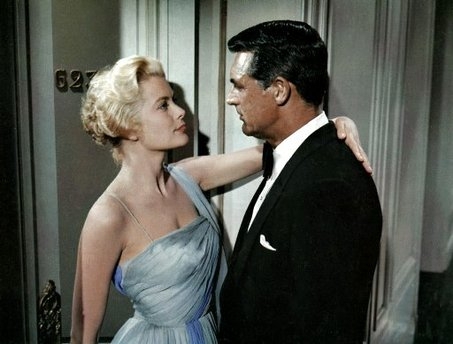
To Catch a Thief

What do you think of when you hear the name 'Alfred Hitchcock'? Most movie fans go right to the thrillers, suspense and psychological thrillers he made during his well-documented career. But not all Hitchcock's movies qualified as any of those three sub-genres, like 1955's To Catch a Thief, a definite change of pace compared to movies like Psycho, Vertigo, or North by Northwest.

If anything, this is the director at his lightweight best showing he doesn't always have to be dealing with international intrigue or murderers hunting people down. With a good story, filming locations on the French Riviera, and perfect chemistry between leads Cary Grant and Grace Kelly, it's hard not to like this movie.

Former jewel thief Mark Robie (Grant) is living in his villa on the French Riviera without a concern in the world. But the newspapers start to report on the return of 'the Cat,' a famed jewel thief identified as Robie, who is starting to pull off elaborate robberies of all the rich women in the Riviera. If someone has expensive, lavish jewelry, the Cat will find them. Forced to prove his innocence and working with French police, Robie goes undercover to try and root out the actual thief before more crimes get pinned on him. It's during his investigation he meets Francie Stevens (Kelly), a rich, young American woman traveling with her mother who happens to travel with her fair share of expensive jewelry.

It's not long before Francie figures out who Robie is and with a naive sense of what's going on, wants to help him find the impersonator, the actual thief. But who knows, could Mark Robie actually be using his time away as a cover while he's actually pullling off these jobs? Hitchcock drops just enough hints to make viewers wonder if maybe Robie isn't on the straight and narrow path.

While the jewel thief is obviously the main focus of the movie, the treat is watching Grant and Kelly interact. So often movies from the 1950s just threw two actors together and forced chemistry on them. Not so here as the duo has an obvious chemistry. Cary Grant is one of the coolest, most suave actors to ever come out of Hollywood, and this is Grant at his coolest. He never looks like he's trying too hard, and it works. I know I believe it because most of the time Cary Grant is playing, well, Cary Grant. I was also impressed with Grace Kelly who I didn't care for in High Noon or Mogambo. But Hitchcock is able to get something out of her that other directors weren't because just like in Rear Window, she's dead-on here as Francie Stevens.

It's their back and forth, their interplay, like this exchange with some subtle fireworks that makes the story come to life even if Grant was 25 years older than the future Princess of Monaco. Hitchcock always had strong female characters in his movies, often thin, pale blondes like Kelly and Kim Novak among others, and Kelly's Francie is certainly no damsel in distress. With some help from the other players like Jessie Royce Landis as Francie's mother and John Williams as a straight-laced insurance agent, there's even some comedic moments as Grant's Robie continues his investigation. Charles Vanel co-stars as Bertani, an old friend of Robie's from his days in WWII in the French resistance, and Brigitte Auber as Danielle, a young French girl with a crush on Robie.

With such a respected director like Hitchcock, you can't help but notice how polished this movie is from start to finish. Filmed entirely on the French Riviera, it might as well be a vacation preview for any would-be travelers. Cinematographer Robert Burks even won the Oscar for Best Cinematography, and it's clear why, the movie's visuals are ridiculously good-looking. The colors come alive whether it be Robie and Francie walking on the beach or a mountain lane car chase. It seems like making a movie that looks good would be easy, but some directors take it for granted. Not Hitchcock, and not here.

Definitely one of my favorites from Hitchcock right up there with North by Northwest and Vertigo thanks to Cary Grant and Grace Kelly's chemistry, a script ripe with great one-liners, and a general sense of this is how a movie should be made.

To Catch a Thief <-----trailer (1955): ****/****

Tuesday, February 3, 2009

Rear Window


I've always been aware of director Alfred Hitchcock with his movies and TV show. I've always known he's respected as one of the best directors of Hollywood's Golden Age and beyond. But even knowing that, I never really sought his movies out even though I've really enjoyed the ones I've seen, North By Northwest and Vertigo especially. So when Rear Window was on TCM this past weekend I thought I'd give it a try.

Through the first half hour or so, I thought maybe I was missing something. Jimmy Stewart is L.B. Jefferies, an out of work photographer who's been hobbled for weeks with a heavy cast on his left leg. In his small two-room apartment, Jefferies gazes out the window and keeps tabs on his neighbors because he's got nothing else to do. One night, unable to sleep but dozing off here and there, he sees a neighbor in the apartment across the courtyard, Lars Thorwald, leave and return three times with a large metal suitcase. After that, Jefferies doesn't see Thorwald's wife anymore.

Could he have murdered her and disposed of the body by cutting it up and hiding the body parts all over New York? The clues seem to point to that, and soon Jefferies has his girlfriend/fiance, Lisa, and nurse Stella, believing his wild theories too. The movie's pace picks up by the 30-minute mark and doesn't really slow down at any point. The pace hits breakneck speed in the last half hour as the trio decide to "go on the offensive" and find out what really happened.

Just like 12 Angry Men, Rear Window uses just one set for the whole movie, specifically Jefferies' little apartment and then the whole apartment complex around him. As a viewer, the whole movie is told from the perspective of the apartment with a hobbled Jefferies, sometimes from his exact POV whether it be a long-lens camera or a pair of binoculars.

So many Hitchcock thrillers are known and respected for their twist endings, but Rear Window goes down the opposite road. Are we supposed to believe Jefferies as the amateur detective? Did Thorwald actually kill his wife? The ending is good regardless, you should get butterflies during the Thorwald apartment showdown, and the same when Thorwald realizes he's being watched.

Besides Jimmy Stewart, the cast is strong all around, especially Raymond Burr in a pre-Perry Mason part as Thorwald. He's one of cinema's creepiest villains, and he doesn't even have a close-up until the last 10 or 15 minutes of the movie. I've never understood Grace Kelly's appeal when it comes to the acting department, her looks were never in question, but the future Princess of Monaco is excellent here. She starts off as the basic upper-class girlfriend, perfect in every way, but rises above the stereotypical part when she sides with Jefferies in his detective work. Character actor Thelma Ritter is great, providing some of the movie's funnier lines, as Stella, Jefferies' nurse.

So as I try to watch more Hitchcock movies, I'll admit Rear Window isn't quite what I thought it'd be, but it is an excellent movie, especially the finale. I will definitely be looking for more of Hitchcock's movies in the past. And just in case anyone was wondering, I didn't spot the director's cameo this time around.