Certain movie gimmicks bother me more than others. Typically I can deal with just about any of them as long as they're competently handled. But one that has to hit it out of the park for me to abide by it is the voiceover narration, a technique that's been used to death over the last 10 or 20 years. Positive uses that jump to mind include American Beauty and Kevin Spacey, The Shawshank Redemption with Morgan Freeman, examples that are near if not perfect in their execution.
When the voiceovers are handled poorly though, it can drag a whole movie down with it, like 1947's noirish The Arnelo Affair. Film noirs more often than not nailed the main character narrating because it got you into the head of a typically tortured main character trying to deal with some inner demons. Without any actions or dialogue, we get to know the character without a lot of background. Those were usually cool characters though. 'Arnelo' is certainly a departure from the tough noir anti-hero with the perspective of a lonely housewife contemplating an affair just not being interesting enough.
After years of marriage to her lawyer husband (George Murphy), Anne Parkson (Frances Gifford) is in a bit of a mid-life rut. She has everything she could ask for, but her husband takes her for granted, basically ignoring her even though he doesn't realize it. Looking for any sort of excitement, Anne meets a client of her husband's, a club owner, Tony Arnelo (John Hodiak), and gets that excitement. But as appealing and attractive as she finds Tony, she quickly finds out there's more than meets the eye. Tony gets involved with an actress who is found dead soon after, but the sneaky club owner turns the tables on her, possibly pinning the murder on her. Can she get herself out of the situation before she's in too deep?
Something was missing from this movie, but I'll start with the narration supplied by Gifford's Anne. First, it's the most banal stuff I've heard in awhile. "I like him, but why? What's going on in my head? I'm married so I shouldn't do it...but I'll see him anyway." The first 45 minutes of an 86-minute movie is dominated by this never-ending stream of conscious narration that drove me up the wall. If you're going to hit the audience with a lot of voiceover while the main character sits at a table looking worried, you've got to at least attempt to make it interesting. But because it's dull as all get out, you're basically watching a book on tape. Nothing interesting visually to look at, and nothing interesting to listen too in terms of dialogue.
Certain names come to mind when I think of femme fatales in film noir, and no offense intended, but Frances Gifford isn't one of them. A wife stuck in a rut at home with a husband that isn't interested in her certainly has some potential, but there's no conflict here. Maybe the censors went to town on the finished product from director Arch Oboler (<--- cool name, huh?) and took out any scandalous revelations, but there's a hole in the middle of this movie that needed filling. Husband ignores wife, wife visits mysterious club owner, they TALK, other woman ends up dead, and we've got a case of blackmail. Apparently somewhere in there Hodiak falls in love with Gifford while blackmailing her and her family. It just doesn't come together, but it is 1947 so in the end everything is wrapped up nicely with a big red bow, including happiness for the precocious pre-Quantum Leap Dean Stockwell with a reunited family.
Once everything hits the fan for Gifford's Anne, she basically shuts down as a human being. She wasn't much of an actress through the first part of the movie, and it only gets worse as things move along. Her character isn't that well-written, but you've got to chalk some of it up to her. It's just not an interesting lead character. Murphy is pretty clueless as her lawyer husband (hate to have him defending me in court) who doesn't realize he's driving his wife away with his constant ignoring her. Hodiak -- one of my favorite character actors -- is a bright spot with a smaller part as Arnelo, the club owner with some definitely shady connections. He keeps you guessing as to Arnelo's intentions because he's charming in his evil way. Other worthwhile parts include Warner Anderson as Detective Leonard, the investigating officer in the murder of the actress that links all these people together.
By the time the murder occurs near the midpoint, the movie's pacing does pick up. The second half of the movie is noticeably better than the first half, but it's not like that was hard to do. As mentioned, everything gets wrapped up too quickly, too nicely and with a little bit too much coincidence for my liking. Not a lot to recommend about this dull noirish flick, maybe for diehards only.
The Arnelo Affair <---TCM trailer (1947): * 1/2 /****
The Sons of Katie Elder
"First, we reunite, then find Ma and Pa's killer...then read some reviews."
Monday, October 11, 2010
Sunday, October 10, 2010
The Miracle Match
Americans love their football, their baseball, their basketball, even hockey has had a bit of a rebirth over the years. But every four years with the World Cup and every so often in between on countless ESPN shows, the U.S.'s struggle to become a soccer nation comes up. Why can't Americans embrace this sport that is the most popular sport by far around the world? I grew up watching and playing the sport so I'm an easy convert, but I've never understood the disdain and hatred certain American sports fans have for the game.
When the U.S. National team advanced to the elimination round this summer in South Africa, it brought up the inevitable "Could this be the event that propels soccer into the U.S. limelight?" discussion. It comes up every two or three years with big wins or events like past his prime superstar David Beckham joining the L.A. Galaxy three years ago. So can soccer every become extremely popular in the United States? Who knows for sure. By now maybe you're guessing where I'm going with this. Looking for a way to drive possible fans away? Show them 2005's The Miracle Match, the true story of the U.S. at the 1950 World Cup.
The true story is of a 1-0 upset the United States team won over powerhouse England in the 1950 World Cup, a victory that still resonates because it was the ultimate underdog story, the ultimate team that shouldn't be there winning a huge game. It's the type of story that should translate well to a movie. Think of Rudy, Hoosiers, Miracle, The Blind Side and countless other inspirational sports movies that stick with viewers long after viewing. Well, 'Match' follows the same basic formula that made those other entries so good, but it falls flat on its face. It's so sticky sweet with these underdog Americans while shoving the U.S. patriotism down the viewer's throats that it never makes any impact at all. Potential for a winner, definitely, but that's all it is; potential.
I knew when I was in trouble almost from the get-go when an opening prologue introduces a reporter (Patrick Stewart) at the 2004 MLS All-Star game, much older now but the only U.S. reporter who even covered the 1950 World Cup in Brazil. He starts to talk adoringly about how epic the game was, how this ragtag group of amateur American players banded together, how they shocked the world. That's the whole movie. The 1950 team is treated like gods who changed the course of history. Sure, the 1-0 win over England was beyond believable, but you know what the Americans did in the other two pool play games? Lost 3-1 to Spain and 5-2 to Chile. At no point does 'Match' even mention the rest of the games or any sort of context as to what the game meant. It didn't change much at all and is a stand-alone of what sports can do. Goliath doesn't always win, but don't try and convince me this team was welcomed home like conquering heroes.
Playing actual people -- especially when they're still alive -- can be tricky so 'Match' plays it as safe as possible. Every character is from the cookie-cutter school of generic sports figures. A pre-300 Gerard Butler plays Frank Borghi, the U.S. team's very talented goalkeeper and really the only character with any sort of personality, anything of interest about him at all. Wes Bentley plays Walter Bahr, one of the greatest all-time players to play for the U.S. and a member of the National Soccer Hall of Fame. Bentley gives little personality to the part, and it's hard to believe him as a leader of a soccer team because he doesn't even convince the viewers of his ability, much less his teammates. No one else in the cast makes much of an impression except John Rhys-Davies as national team coach Bill Jeffrey, maybe the worst portrayal of a coach I've ever seen in a movie. It looks like he's sleepwalking 90% of the time.
Now on to the soccer. Any sport can be tricky to translate to a screen because acting is one thing. Physical confrontations in a game that is almost entirely unpredictable? Downright impossible. The soccer scenes -- and there's plenty -- lack any energy, any drive. The actual World Cup game is well handled although the one goal scored comes as a bit of an anticlimax. Honestly though, the movie was lost to me long before the final 20 minutes. Director David Anspaugh supposedly had his budget cut from $65 to $27 million so the version we see is not the one he intended. I'm hard-pressed to think of much that could make this movie that much better. Pass.
The Miracle Match <---(2005): * 1/2 /****
Saturday, October 9, 2010
Hot Tub Time Machine
Sometimes all it takes is a movie title to draw you in. It doesn't matter who is starring or who is directing, what the story is or if it's a drama, comedy, action, or romantic comedy. The title can say everything you need to know before you see one scene from a trailer. I was originally skeptical of this flick, thinking it looked like one of the stupidest movies I'd ever heard of. But after more than a few positive reviews from people I have common interests in with movies, I caved and watched 2010's Hot Tub Time Machine.
When a movie's title is Hot Tub Time Machine, do you need to know anything else? You're not going in to this movie as a viewer thinking you're about to see Citizen Kane or The Godfather. What completely caught me by surprise was that even with its fair share of stupid, gross-out humor, 'Time Machine' is a genuinely funny movie. It feels like a throwback to a lot of the raunchy comedies that are so often associated with the 1980s with its mix of John Hughes comedy and Back to the Future like situations. A classic it is not, but certain scenes made me laugh until I cried. Any movie that does that is okay in my book.
After drifting apart over the years, three high school friends, Adam (John Cusack), Nick (Craig Robinson) and Lou (Rob Corddry) reunite for one huge weekend fling. With Adam's nerdy nephew Jacob (Clark Duke) along for the adventure, they head to Kodiak Valley, a ski resort they visited often as high schoolers with generally raucous results. Partying in their suite's hot tub, they all pass out, waking up the next morning to find they've gone back in time to 1986 on a weekend they'd visited in the past. The four friends must decide what to do, not miss with history and try to get back to 2010 or have some fun with this predicament. At first, they decide to do exactly what they did the same weekend back in 1986, but what's the fun in that? Enjoy yourselves!
Subtle humor this is not, but if you've made it this far into a review of a movie called Hot Tub Time Machine I guess you know that by now. Even with the stupid humor, the laughs come from some great nods to classic 80s movies, and of course the crew's general confusion as to how exactly they've traveled back in time to 1986. If that wasn't enough, I'll recommend this movie for one line and one line only. Everything else is just gravy because it is one of the most flawlessly delivered lines I've ever seen. When they figure out what's going on, Robinson states in a deadpan voice "It must be a...hot tub time machine" right as he looks up at the audience. Watch it HERE. A movie that knows how ridiculous it is and embraces it always gets points from me.
When I first saw the trailer, everything looked normal for a raunchy R-rated comedy with one major exception. John Cusack? Really? You've got no other offers on the table. An iconic actor from the 1980s, he somehow seems out of place here and just doesn't provide many laughs. He looks to be sleepwalking through the part. Thankfully, Robinson (one of the best comedic actors around right now) and Corddry are there to pick up the slack. Robinson's Nick is dealing with his long-time girlfriend cheating on him with some hilarious results while Corddry is the self-proclaimed asshole of the group because every group of friends has one. It's their delivery, their physicality, everything works for these two. Duke's Jacob generally plays straight man but gets some great laughs anyways with his subtle deliveries of some great lines. Check out IMDB's memorable quotes for just a sampling.
Now it is a time travel movie so you've got those issues that any movie that's ever dealt with time travel...yes, even in a comedy. By going back in time, can you change the future like Marty McFly? Will one little thing epically change the course of time? Of course, there's the Back to the Future references, an excellent, hilarious analysis of the first Terminator movie and how it applies, and a running gag with a bellhop (Crispin Glover in a perfect supporting part) who we know loses his right arm, but not how. It's only a matter of time before it happens, and when it is revealed, it doesn't disappoint. On top of it all, there's Chevy Chase as the all-knowing janitor who knows exactly what's going on but refuses to let anyone in on it. He's in the movie maybe 8 minutes total, and he steals every scene he's in.
I don't know what else to say. More than pleasantly surprised with this movie that I assumed would be one of the worst I'd ever seen. Sure, there's some glitches, and not all the jokes work but a majority of them do. Entertaining, hilarious, and highly quotable. Highly recommended.
Hot Tub Time Machine <---trailer (2010): ***/****
Labels:
2010s,
Chevy Chase,
Comedy,
Craig Robinson,
John Cusack
Friday, October 8, 2010
Robin Hood
Some characters from historical literature have just had more of an impact than others, characters like Hawkeye in Last of the Mohicans, Captain Ahab in Moby Dick, King Arthur, Tom Sawyer and Huckleberry Finn just to name a few. One that I started reading about when I was younger who still remains a favorite is Robin Hood. Countless books have been written about the legendary outlaw and even more film versions that include stars Errol Flynn, Sean Connery, Kevin Costner, and even a Disney animated version that I love. Well, they can't all be winners, like 2010's Robin Hood.
A pairing of director Ridley Scott and star Russell Crowe with a great character like Robin Hood seemed like a no-brainer to me (Gladiator for anyone confused) even though I never got to see it in theaters. Going into this, I should say I'm a fan of the legend, the myth of Robin Hood. Like so many movies dealing with stories already known by audiences (Bond, Batman, Hulk), Scott goes with a reboot, telling the story of how everything we know about a character -- in this case Robin Hood -- came to be. So basically, it's an unofficial prequel. Bigger than that though, the title character is almost a throwaway addition. This movie could have been any 12th Century archer fighting royalty. I wanted to like this movie, and it just didn't happen.
After fighting for King Richard the Lionheart (Danny Huston) in the Crusades for 10 years, archer Robin Longstride (Crowe) returns home to England with three of his closest friends and allies he's fought these many years with. Completing a mission he told someone he would honor, Robin rides to the town of Nottingham where he meets Sir Walter Loxley (Max von Sydow) and his daughter-in-law, Marion (Cate Blanchett). He agrees to say on with them, posing as Marion's dead husband so they can hold on to their land. Bigger things are at work though as a treacherous Englishman, Godfrey (Mark Strong), is pitting new king John (Oscar Isaac) against his people while also arranging a surprise invasion from the French. Standing in their way is Robin himself, ready to defend England to the last.
I made the unfortunate decision of watching Scott's Director's Cut, clocking in at 156 minutes instead of the theatrical 141 minute-version. Bad choice. I'm all for historical epics in just about any form, any historical time period, but there's both too much going on here and not enough at the same time. Maybe the best thing going for the movie is the cast, but there's too many worthy actors here so they're in and out of the story too much. After the introduction of all the players and settings, basically an hour goes by before any conflict is even introduced. Then when it is presented, it's another 30 minutes before SOMETHING ACTUALLY HAPPENS. Maybe I was expecting a different movie, but I was bored to tears and only stuck with it because I kept waiting for it to get better. Insider tip? It doesn't.
With Scott directing and Crowe starring, Gladiator is one of my all-time favorites. Reviews even identified this one as Gladiator with a bow and arrow. Playing the title character (although he's only identified as Robin Hood once), Crowe makes this otherwise dull flick somewhat interesting. The man is cut out to star in historical epics, and he makes Robin a believable leader, a man capable of convincing others to do something they never would have on their own. Crowe also looks to do most of his own stunts -- fighting and horse riding -- so he gets points just for being cool. As Marion, Blanchett is like a female equivalent of Crowe, an actress cut out for period pieces. The two of them have some definite chemistry, but it gets lost in an endless series of scenes that go nowhere.
The name recognition alone for the supporting cast is great, but that's about all they get. Over 80 now, von Sydow is still the man and just by being in the movie makes it better. William Hurt looks like he stumbled into the wrong movie playing William of Marshal, a royal caught in the middle of a possible English civil war. Strong is a great villain, a man with NOT ONE redeeming quality, making it that much easier to hate him. Matthew Macfayden is the sheriff of Nottingham, relegated to background duty here. Huston makes the most of a quick appearance as the Lionheart. Robin's not so merry men include Friar Tuck (Mark Addy), Little John (Kevin Durand), Will Scarlet (Scott Grimes) and Alan A'Dale (singer Alan Doyle). I would have loved to see a movie more about Robin and his men in Sherwood Forest, but I guess I can add that to my list of complaints.
One thing that still surprised me about this movie was the PG-13 rating because without the R-rating, the action and violence seem pretty tame, almost boring. I don't need decapitated heads or gushing blood, but it felt very whitewashed here. Not that the action is top-drawer by any means, but it was certainly more watchable than just about anything else here. Like the rest of the movie, it just didn't impress. On scale alone, this movie gets some points but other than Crowe, Blanchett and an underused supporting cast, I've got to pass on this one. A disappointing result, and a surprising one too.
Robin Hood <---trailer (2010): **/****
Thursday, October 7, 2010
The Running Man (1963)
In a career that spanned just over 30 movies, Reed carved a niche out for himself as a solid storyteller able to make the usual/the norm visually interesting. Of the movies I've seen of his, the camera style is unique with a variety of types of shots from angles and perspectives you wouldn't normally think of. He often filmed in black and white -- although not in 'Running' -- and had an eye for creating a movie that was interesting to watch in terms of story and to the eye, never a boring sequence in sight. Okay, maybe one or two, but less than most directors.
After an insurance claim is denied because he let the renewal go a few days late, pilot Rex Black (Laurence Harvey) concocts a plan to get some badly needed money. He fakes his own death in a crash at sea after signing up for a new insurance plan, and a few months later his wife Stella (Lee Remick) gets a check from the insurance company that assures they'll never be poor again. Stella waits a few months and meets Rex -- now posing as an Aussie businessman with bleach blond hair -- in Spain where they prepare for their future. Rex begins to bring up the idea of pulling the insurance scam again only to have a surprise dropped in his lap. The insurance agent (Alan Bates) who handled the recent case with Stella is in Spain too. But what are his intentions? Is he vacationing or investigating? Paranoia and worry settle in, but can Rex and Stella figure out what's going on before it's too late?
If I've figured anything out about Reed and his storytelling technique, it's that he likes to keep his viewers guessing. And after some slow early moments here, Reed ratchets up the tension with each passing scene. When Bates' Stephen shows up in the same Spanish town, the new couple of crooks are instantly put on the defensive. Rex and Stella can't be mean or ignore this curious stranger without setting off alarm bells, but is Stephen just interested in Stella or is it something deeper? Even though they're crooks, I found myself rooting for the couple, well maybe just Stella. There's not really much of a twist when the answer comes, but the more surprising things come in the last 20-30 minutes after the supposed twist.
For a story meant to keep you on your toes, Reed has a way of disarming you in the same scenes he sends a shiver up your back. The movie was filmed in Andalucia and Gibraltar, and for fans of spaghetti westerns, you even see some familiar locations, especially the bullfighting ring from A Bullet For Sandoval. So while the story develops, the background works almost as a travel guide for the area from the sun-swept country roads near the ocean to the idyllic little towns with its motels, markets and vendors. Choosing not to film in black and white was a wise choice here as Spain gets to show off its beauty.
As the credits rolled at the beginning of the movie, all I could think was "Man, after those first three names I don't recognize anybody." Well, my worries were unfounded as the main trio dominates the movie with little outside interference from the supporting cast. I continue to catch up with Harvey who I've only see in four or five movies. He can be very theatrical in his parts, but the guy can straight up act. His character goes through the biggest transformation, and not always a good one; a slighted man looking for a second chance after a mistake to a vengeful, greedy individual wanting piles of cash. Remick is his wife, a woman who loves her husband despite what he becomes. Bates is the wild card, keeping you guessing as to exactly what's he up to. Of the supporting cast, the only face I recognized was Fernando Rey as a Spanish police investigator.
During the last act of the movie, the old idea that "bad things happen to bad people" certainly rings true. I didn't necessarily like the ending as one character keeps a huge secret to themselves rather than reveal it. The impact is obviously huge and caught me off guard and disappointed at the same time. None of this is enough to deter me from recommending the movie. After those early struggles with pacing, 'Running' finds it rhythm and quickly settles in for the ride.
The Running Man <---TCM clips (1963): ***/****
Labels:
1960s,
Carol Reed,
Fernando Rey,
Laurence Harvey,
Lee Remick
Wednesday, October 6, 2010
River of No Return
I've written before about my general dislike for movies from the 1950s, but as I watched 1954's River of No Return I couldn't come up with a thing to write about. The cast, the director, the premise, the setting, all sounded positive and at least worth giving it a try. All those things mentioned were worthwhile too, but like so many 50s westerns this oater lacked any heart, any reason for us as viewers getting really involved in it. Good in a lot of ways, above average in some others, but overall just a boring western.
Because the movie didn't leave much of an impression on me as a whole, I debated just ending the review there with that first paragraph. But then I'd feel bad for not giving it a fair shake if nothing else so here goes. Like so many other 50s westerns, 'River' tries to dazzle the viewer with the spectacle of what's going on in the story from the widescreen filmmaking to the Cinemascope camerawork to the breathtaking locations. Try and keep up with that, Television! But that's where it stops. Characters aren't that interesting, the premise is promising but never goes anywhere, and in the end lands with a clunk despite the talent involved.
Working a small farm amidst a raging gold rush, farmer Matt Calder (Robert Mitchum) sends for his son, Mark (Tommy Rettig) when he discovers his estranged wife has passed away. Everything goes smoothly as the two Calder men cut out a new life for themselves in the wilderness. One day though, Matt saves a runaway raft on the river, rescuing a gambler named Weston (Rory Calhoun) and his fiancee, Kay (Marilyn Monroe), from almost certain death. Weston has to file a gold claim and steals Matt's horse and rifle, leaving the trio on their own with no protection. Matt sets out after the gambler with Mark and Kay in tow, navigating the treacherous river in hopes of catching up to the man who shanghaied them.
I can't say I intentionally avoided this flick over the years, but I never actively sought it out either. But reading through filmographies lately, I stumbled upon it again and saw Mitchum and Monroe's names and then director Otto Preminger too and finally caved and gave it a try. I didn't hate it, and I didn't love it. It's one of those instantly forgettable movies that has some positives going for it but never amounts to anything bigger and better. The filming locations in Banff National Park in Alberta, Canada are drop-dead gorgeous and Preminger knows it, shooting the green mountains like they're leading up to heaven. The location shooting is one of the high points of the movie, but I struggle to recommend a movie based solely on how it looks.
Mitchum is one of my favorites, and even in schlock movies usually makes the most he can out of the badness. His Matt Carlen is a typically Mitchum western hero, stout, strong, and honest as a man who says few words and doesn't like to be pushed. It's not his best work, but he was always very watchable and doesn't disappoint here. At the height of her popularity, Monroe never looked better and also shows she was more than just a ditzy blonde. The girl could act and even gets a chance to sing -- 5 chances actually -- to show off her voice. Mitchum and Monroe have some chemistry together, but a forced love scene late puts a damper on any fireworks that might have been possible. Calhoun as always is a worthy villain, slimy and backstabbing to the end, and Rettig handles himself well, avoiding any annoying child actor comparisons.
Filming a story that requires the cast to navigate down a dangerous river puts Preminger in an awkward spot right from the start. A studio isn't going to allow big names like Mitchum and Monroe to go anywhere near river rapids so you're forced to improvise. We do get certain shots of them on an actual river in some ridiculously calm water. But then when the raft reaches rapids, we get the super-imposed shots of Mitchum/Monroe/Rettig in a studio on a "raft" with the green screen nature shots behind them. I don't know an alternative other than to not use any close-ups, but then I'd complain about that too. Sorry, Mr. Preminger, looks like you were fighting a losing, can't win battle. Damn studios and their worries.
Little else to add here. Mitchum solid, Monroe shows she can act and looks good doing it, and Banff National Park is gorgeous. An unexciting western that does little to distinguish itself from the pack, and even at just 90 minutes feels like a half hour or so could have been edited cleanly.
River of No Return <---trailer (1954): **/****
Labels:
1950s,
Marilyn Monroe,
Otto Preminger,
Robert Mitchum,
Rory Calhoun,
westerns
Tuesday, October 5, 2010
Baby, the Rain Must Fall
Throughout his cancer-shortened career, Steve McQueen readily admitted he didn't think much of the acting profession he had chosen. It was a job to him, plain and simple, one that he obviously had a talent for but also one he never really embraced as being a legitimate job or occupation. Well, whether he admitted it or not, McQueen was an incredible presence on screen. Critics said he often played the same character -- what successful movie star can't that tag be applied to? -- but as a defender of McQueen, I've yet to come across a part of his that didn't have something to recommend.
To be fair, McQueen did perfect the part of the quiet, loner anti-hero who just doesn't fit in with society and its norms. This formula worked in big blockbusters like The Great Escape and The Magnificent Seven and more character-driven stories like The Sand Pebbles (nonetheless an epic) and Papillon. Early in the 1960s after his star-making part as Cooler King Virgil Hilts in The Great Escape, McQueen made a point of doing different parts and not being typecast as one specific kind of action actor/star. So over two years, he made three movies -- none of which have been remembered well -- including 1965's Baby the Rain Must Fall.
Making the long bus trip across Texas with her young daughter, Georgette Thomas (Lee Remick) is on her way to find her husband who she hasn't seen in years. Henry Thomas (McQueen) is a recent parolee from the state penitentiary looking for a clean slate in life and fully embraces his wife and daughter's return. He dives right into making their lives better, renting a house to live in and looking to take night classes and get a degree. At the same time though, Henry has this dream of selling his country/western songs and hitting it big, becoming the next Elvis Presley. Georgette is on his side supporting him all the way, but Henry's past demons from a difficult childhood start to emerge, making an already difficult task nearly impossible.
Director Robert Mulligan crafts an intriguing story here that has drawn comparisons to the stories and plays of Tennessee Williams. Intriguing doesn't always translate to interesting though. Filming in black and white, Mulligan makes what looks like a 1960s version of The Grapes of Wrath. With his Texas locations, there is a sparseness, an emptiness to the story. Big wide open stretches of land with the wind blowing by with nothing to stop it. The story is focused on Henry and Georgette and a handful of supporting characters, and it is always grounded in a very human, very realistic way. All said though, it's too bleak, too dark with no real hope of a peaceful resolution. You know before it starts that this is going to have a tragic ending, you just don't HOW exactly it's going to go down.
As a fan of McQueen, I'll admit that I'd watch the man read a phone book, sure that he would put some unique spin on his reading. His Henry Thomas character is one of his more underrated parts and is generally unknown thanks to the film's epic tanking in theaters. A good jumping off point is that from the start, McQueen makes Henry a very likable character. You're rooting for him to hit it big, become a star. In preparing for his part, he uses a lot of his own personal experiences from his own checkered past and troubled childhood to really get to know the character. As Henry devolves into a shell of himself, it's startling to watch the transformation. It is uncomfortable watching it at times as McQueen brings a ton of intensity to the performance. This isn't as iconic as Hilts gunning his motorcycle across the countryside or Det. Bullitt racing through the streets of San Francisco, but it proves without a doubt that McQueen was a great actor...if there was ever any question.
In a part that could have been overshadowed by McQueen's powerful performance, Lee Remick more than stands her own as Henry's wife, Georgette. Remick's looks definitely play into the character, but for the better. She is this extremely thin blonde young woman who looks like a stiff wind could knock her over. Add in her girl next door looks and a Texas drawl, and you figure you've got this character pegged. You'd be wrong. Her Georgette has lived for years as a single mother (a great mother at that) and is as tough as they come. She's not going to let anyone or anything slow her down. Add in her obvious chemistry with McQueen, and you've got quite a pair in the lead roles. Also starring are Paul Fix as the town judge, Don Murray as the local deputy who grew up with Henry and knows his past, and young Kimberly Block in her only acting performance as Margaret Rose, the Thomas' daughter.
One other complaint, but it's a pretty bad one. McQueen plays a country singer with one major problem; McQueen couldn't sing a lick. Anytime Henry sings, we see McQueen lip-synching to the lyrics, but it's clearly someone else singing. The voices just don't match up. Check one example out HERE. It completely takes you out of the flow of the movie, and these scenes can be painful to watch. Still, McQueen and Remick are great leads, and that's the main reason to check out this forgotten flick from the 1960s.
Baby the Rain Must Fall <---trailer (1965): ** 1/2 /****
Labels:
1960s,
Don Murray,
Lee Remick,
Paul Fix,
Robert Mulligan,
Steve McQueen
Sunday, October 3, 2010
Blood Alley
The movies range from straight propaganda like Big Jim McClain -- a movie so bad that it is good -- to others that were slightly...slightly...more subtle. A not so thinly veiled at Communism and everything negative about it, 1955's Blood Alley isn't completely done in by the attempt, but it sure doesn't help. Lack of subtlety aside, it's just not a very good movie. Through the 1950s maybe more than any other decade he worked in, Wayne was very much so a hit or miss star. For every 'The Searchers' or 'Rio Bravo' there was The Conqueror where he played Genghis Khan or Jet Pilot, another dig at Russia and those clever Commies. 'Alley' certainly is a change of pace, but not a good one.
After two years in a Chinese Communist prison, ship captain Tom Wilder (Wayne) escapes with some unknown, outside help only to find he's being recruited. A village under Communist control is seeking to escape from its life of misery, and all they can come up with is one desperate plan. Wilder will hijack a ferry that travels up and down the rivers, transporting all 300 villagers to Hong Kong where they will be out of the grasp of the Commies. The plan is basically suicidal, but Wilder for some reason agrees to help, maybe because of the pretty daughter (Lauren Bacall) of an American doctor working nearby. The odds are against any sort of success on the mission, but given a crack at doing something right, Wilder takes his chance, odds be damned.
A story set in 1920s China is nothing new to movies, but one example -- a much better example -- kept coming to mind, 1966's The Sand Pebbles. There was an epic scope, a huge cast, a worthwhile message, all working toward the same goal. Here with Blood Alley, director William Wellman just never puts it all together although I question if all the composite elements were every really there to be molded. There isn't so much a story as a series of scenes with Wayne and Bacall talking, followed by some efforts to obtain the ragged-looking ferry, and then an hour or so of said ferry going down the river to safety. There's no conflict, no bad guys pursuing them, no real threat of danger so what's the point of it all?
In another case of the odd casting department, Wellman goes all out both in terms of actual casting but then how the Chinese are portrayed. White actors Paul Fix, Mike Mazurki, and Swedish cutie Anita Ekberg all play...you guessed it, Asian characters, awful eye makeup and horrific accents included. I've asked before, and I'll probably ask again, but there weren't any Asian actors available for these laughably bad parts? The few Asian actors actually cast, like Joy Kim as Susu, Bacall's maid, and Henry Nakamura as Tack, the ferry engineer, are definitions of what playing an Asian stereotype is in older movies. These portrayals aren't offensive or anything of the sort, but you just feel embarrassed watching them just the same.
Wayne and Bacall would reunite a little over 20 years later in The Shootist for Wayne's last movie. The duo showed off a perfect chemistry as the two pros played off each other like peanut butter and jelly. Their scenes carried the movie, and it was a treat watching them do their thing. Some 20 years earlier, that same chemistry just ain't there yet. Wayne seems to be sleepwalking here and just doesn't deliver one of his better performances. Bacall was as sexy as ever and is a great actress, but a poorly written part has her doing nothing but looking worried or distressed. In The Shootist, their almost 15 year age difference wasn't an issue, but here Wayne looks much too old for the 31-yard old Bacall. There's also Wayne's address to the villagers, imploring them to think for themselves and not listen to "the old man"....cough Communism cough. Subtle it is not, more like a sledgehammer landing.
As for winding this bad boy up, one more complaint. With a story set in 1920s China, a fair amount of Chinese is spoken. Makes sense to me. No subtitles are there as the "bad Chinese navy" mumbles and screams through their lines (comic relief maybe?) or as any of the Chinese characters interact. So on top of the long, unedited sequences of a ferry going down a river, there's also long shots of characters speaking in a language where no explanation is offered. This is one of the few Wayne movies I'd never seen before, and I'm kinda glad it's out of the way now. Pass on this stinker.
Blood Alley <---trailer (1955): */****
Labels:
1950s,
Anita Ekberg,
John Wayne,
Lauren Bacall,
Paul Fix,
William Wellman
Friday, October 1, 2010
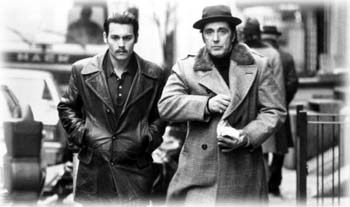
Donnie Brasco
Al Pacino has done countless characters that all are applicable answers when fans are asked for their favorites. But over three movies, my favorite Pacino character has and always will be cold-blooded Michael Corleone. The Godfather movies are on the whole classic movies -- okay, maybe not Part 3 -- and a huge reason for the classic status is Pacino's Corleone. Michael is cold, calculating, brutal and seemingly without emotion as he makes decisions to protect both his family and himself.
It is a character that has stuck with him throughout his career and in some ways typecast him. He's too good an actor to be pigeon-holed though, always experimenting with new, unique parts. Similar in story and background to The Godfather but different in every sense in looking at Pacino's character is 1997's Donnie Brasco. He plays Benjamin 'Lefty' Ruggiero, a mid-level thug who is stuck in his long-time position within organized crime, but because he does his job and doesn't cause trouble, he's not a threat either. So basically, the anti-Michael Corleone, a fast climber on his way to the top. It's an underrated and even a little under-appreciated performance from Pacino in an underrated movie.
It's 1973 in New York and FBI agent Joe Pistone (Johnny Depp) has been working undercover for two years trying to get in with the local hoods. He gets his chance when he's approached by Lefty Ruggiero (Pacino), a made man working for one of New York's big-time mafiosos. Lefty takes to Pistone -- cover name Donnie Brasco -- immediately and begins to show him how things are done, the ways of the business. One of Lefty's associates, Sonny Black (Michael Madsen), is making a positive impression wherever he goes, and he's bringing his crew with him to the top, including Donnie. But as the days turn into months and years, Donnie acclimates to the life to the point he likes his fake life better than his own. No matter how he feels though, it only takes one slip up and the whole ruse will come crashing down.
Mafia movies could have their own wing of a movie library all to themselves with all the quality entries over the year. Surprisingly enough though, Donnie Brasco is rarely mentioned with some of the classics. And to be fair, maybe it isn't a classic, but it's pretty close. It doesn't settle for the accepted stereotypes and never tries to make the mafia look like anything other than a low-down, dirty, bloody, extremely violent life where anyone and everyone could turn on you. Director Mike Newell gets the little things right from the 1970s style of cars and clothes to the camaraderie that develops among this tight-knit group. The writing is pitch-perfect (including THIS absolute classic discussing the meaning of 'Forget about it') and keeps the story flowing. The violence is kept to a minimum for the most part with one big exception, a hit attempt late in the movie, but don't go in expecting buckets of blood.
One of the coolest things a casting director can do is pair established mega-stars with up and coming stars on the rise. You get combinations of great acting duos across movie generations, and the audience almost always comes out on top. Above all else in Donnie Brasco is this relationship between Donnie and Lefty, the mafia made man eventually becoming a mentor to the new guy, almost like a big brother or even a father figure. Through all the trials and tribulations, the two remain friends. As the situation escalates, Donnie even begins to feel guilt at what he's doing. Sure, he's doing his job in the line of duty, but Lefty, Sonny, Nicky (Bruno Kirby) and Paulie (James Russo) have genuinely become his good friends. Of course, as an undercover agent, he knows there is no way it can all end pleasantly, but that's to worry about when the time comes.
Neither Pacino or Depp were nominated for their parts, but I can see how both could have earned at least an Oscar nomination if not a win. Pacino's part is a nuanced one as he somehow makes this very unlikable character into a likable one. He gives Lefty all these little personality traits that alone would seem odd, but combine them and they work as this great red-blooded character. Lefty's final scene -- while insinuating a fictional fate -- is Pacino at his best, a silent scene as he knows he's met his end in one way or another. For Depp, this was before his huge movie star parts, but he shows that no matter the movie he can nail the part. Depp always comes across as very watchable, very personable, even when his character isn't. Teamed with legendary Pacino, and you've got a real winner.
The only thing keeping Donnie Brasco from being a classic in my eyes was the subplot involving Donnie/Joe and his struggles at home with his wife (Anne Heche). These scenes have a been there, done that feel because we have been there and done that with these homefront fights. It's not that they're awful scenes, but compared to anything with Donnie and his infiltration of the mob, they just don't have the same impact. Still, this is a hidden gem, and one that I'm sorry I missed all these years.
Donnie Brasco <---trailer (1997): ***/****
Labels:
1990s,
Al Pacino,
Gangsters,
Johnny Depp,
Michael Madsen
Subscribe to:
Posts (Atom)